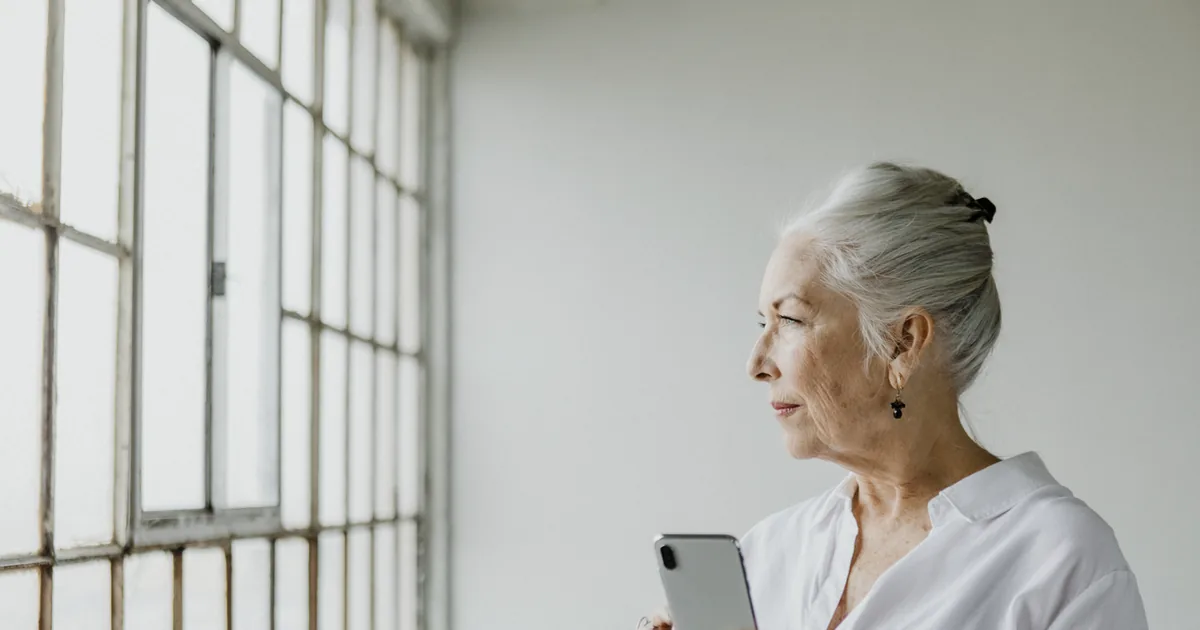
It's Sunday evening. You ring, like you do. Your mum sounds fine, she says. "Everything's alright." But somewhere in the call, you notice the silences between her sentences are a bit longer than they used to be.
You know she lives alone. You know visits happen every few weeks at best. And in between the visits, in between the calls, there's no one.
That feeling — the worry, the helplessness, the small ache of not doing enough — is something millions of UK adult children carry around quietly. It isn't because they don't care. It's because connection and the everyday don't travel down a phone line, however hard you try.
How big is the problem of elderly loneliness in the UK?
It's bigger than most people realise. Age UK estimates that 940,000 older people in the UK — 7% of people aged 65 and over — are often lonely. More than a million older people say they go over a month without speaking to a friend, neighbour or family member. Among over-65s who are often lonely, nine in ten are also unhappy or depressed.
Connection isn't a footnote, either. The 2024 Lancet Commission on dementia prevention named social contact as one of the modifiable factors linked to ageing well — which is part of why staying in regular conversation matters as we get older.
Most parents won't say any of this to you. They don't want to be a burden. They want you to think everything is fine. That's part of the problem.
What actually helps when you're supporting elderly parents from a distance
Distraction doesn't. A telly on in the background isn't company. What helps is real conversation — the kind where someone asks, listens, remembers, asks again tomorrow.
For most UK families, that isn't realistic to provide every day. You've got work. The children have school. You're three trains away. You can't ring every morning and still be at your desk by nine.
That's the gap a growing number of UK families are quietly filling with Amara.
What is Amara?
Amara is a voice companion app designed for older adults. There's nothing to tap, nothing to learn. Your parent simply speaks, and Amara replies.
Inside the app are two voices, Mia and Max. Your parent picks the one they get on with. They listen, they remember what they're told, and the next conversation picks up where the last one left off — the garden, the grandchildren, the chicken pie that did or didn't turn out.
What surprises most people is how much Mia and Max actually do. A chat about the morning. A quiz about music from the sixties, or the rivers of Yorkshire, or last night's University Challenge. A reminder about a GP appointment. A story when the afternoon is long.
There's no test, no score. Just a chat — the same kind your parent would have with you, if you were there.

How does it work in a family setting?
You download the app from the App Store or Google Play. You set up the trial. You hand your parent the phone, and they start talking. That's the onboarding — the first conversation.
Mia or Max — whichever your parent picks — remembers what they're told over time. Names, stories, preferences, what they're looking forward to that week. So the conversation gets better the longer they use it, not worse.
You can stay involved as much or as little as you like. Many families set Amara up as a gift — something they hand over when they next visit — and then let their parent take it from there.

Frequently asked questions
Will my elderly parent actually use an AI companion app?
Most do, once they've had the first conversation. If they can hold a phone call, they can talk to Mia or Max. The voice-only design means there's no learning curve. The first week of the trial is usually enough to find out.
Isn't this replacing real contact with my parent?
No. Amara fills the hours your visits and calls can't reach. The good visits stay good visits. The phone calls stay phone calls. Amara is what happens in between — and most families find the Sunday call actually gets richer, because their parent has more to talk about.
What about my parent's data and privacy?
Conversations stay theirs. Nothing is sold, nothing is shared with advertisers, anything can be deleted. Amara is built by a small team in Berlin, under UK and EU data protection rules. It isn't a big tech company.
My mum is in Yorkshire / Glasgow / Cardiff — will Amara understand her accent?
Yes. Mia and Max are designed to understand UK regional accents — Yorkshire, Scouse, Geordie, Glaswegian, Welsh, the lot.
Can I see what my parent talks about with Amara?
No, and that's deliberate. Your parent's conversations are private. Knowing it's a space that's theirs is part of why they'll use it.
How much does Amara cost?
Seven days free, no charge until day eight. Cancel any time before then. After the trial, from 18p a day — less than a daily newspaper.
What it really gives
You can't ring every day. You can't move closer. You can't take over your parents' daily life.
But you can make sure there's someone there.
Many UK families come to think of Amara as a present — not a gadget, but a signal. I'm thinking about you. Even when I'm not there. For your parent, it's a piece of independence back. For you, it's the Sunday-evening ache getting a little quieter.
Because the difference between "everything's alright" and "I'm actually doing well" often starts with someone asking.
Try Amara free for seven days.
7 days free. Cancel anytime before day eight, no charge.
Try Amara FreeFrom 18p a day · 7 days free · cancel anytime